
The use of modern AI models — such as GPT, DeepSeek, Mistral — has taken website translation automation to a whole new level. This is especially relevant for Tilda websites, where multilingualism is not supported out-of-the-box, and automatic translations from Google, Yandex, etc., require manual adjustments, which is a very labor-intensive and error-prone process, and also does not yield the desired results for website SEO optimization, as they translate the site only after it loads in the browser.
The Multify service translates text not just through single requests to AI models, but uses an entire system — with context awareness and a graph architecture that helps maintain text coherence across the entire site. Below is how it all works.
🔄 Why Context Matters
When text on a website is translated, especially a small fragment of it (for example, a menu item, a button, or a line in the footer), an isolated approach yields inaccurate results. The model may not understand what the phrase refers to, how it is consistent with other elements, and choose the wrong translation.
To avoid this, Multify transmits to the model not only the text to be translated itself, but also its surroundings:
[ text before ]
[ text to be translated ]
[ text after ]
This approach helps the model to "see" the fragment not as a fragmented remark, but as part of a coherent whole.
📍Example
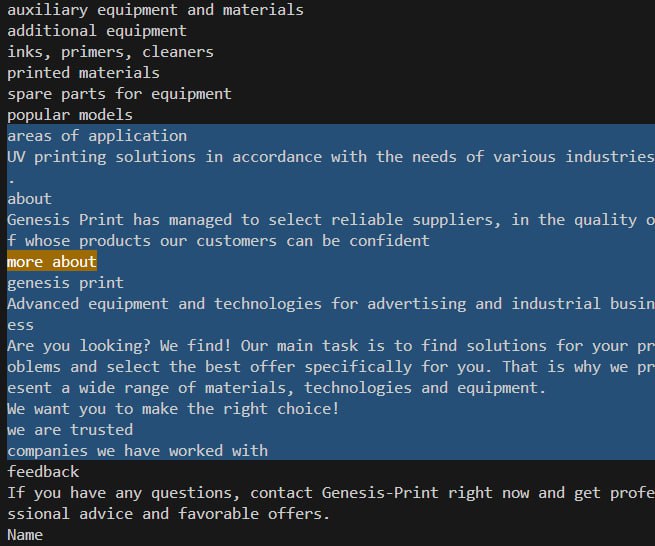
On this site, when translating the "more about" button, the model takes into account the context of the upper and lower blocks:
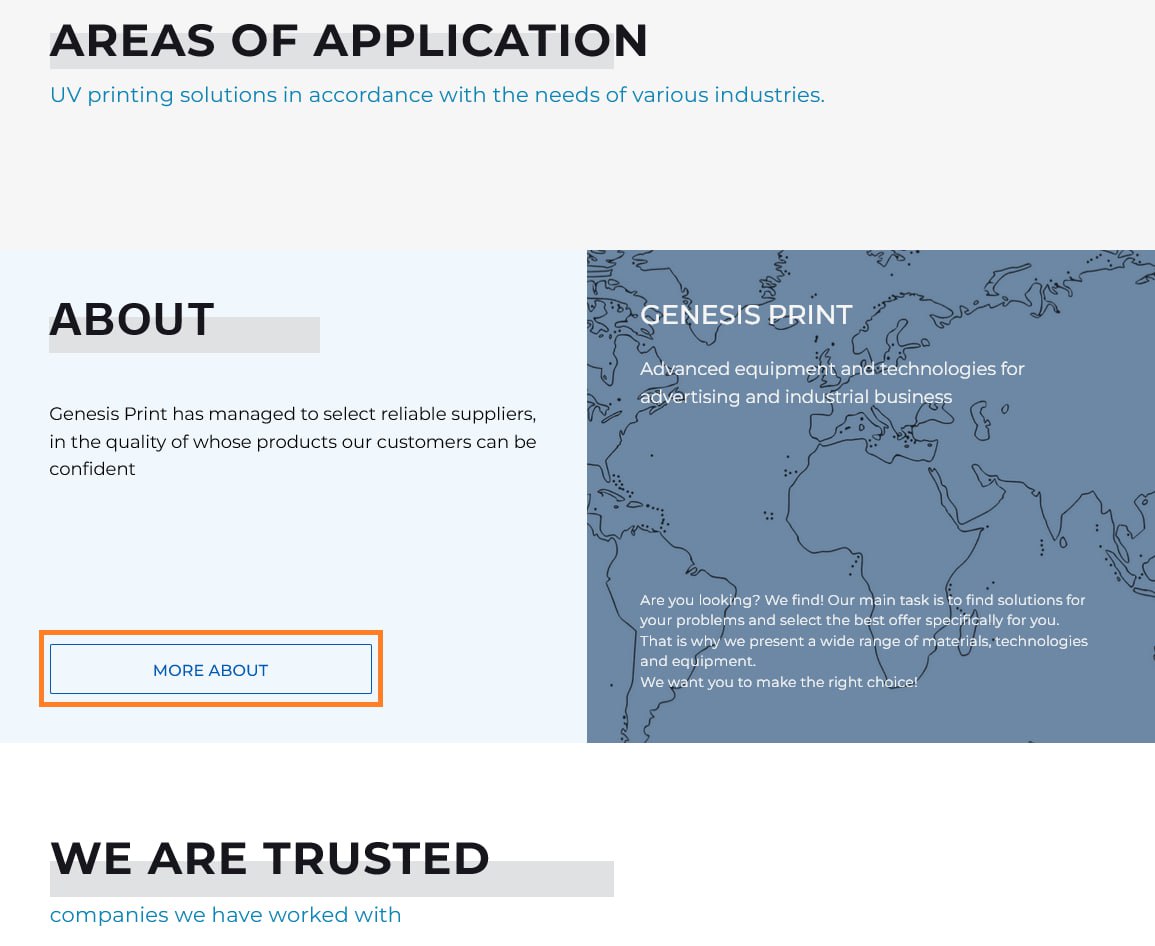
In the code below, the considered context around the "more about" button is highlighted:
➰ Graph Structure: How Context is Formed
To define the environment of fragments even more accurately, Multify breaks down the entire document (web page) into blocks and forms a bidirectional graph from them. This means that:
- Each text element knows which blocks are next to it.
- If a new fragment is added in the middle of the page, its "neighborhood" can be automatically determined.
- The model receives not only the fragment itself, but also logically related blocks — even if they were translated earlier.
This approach helps to maintain semantic integrity, as well as grammatical consistency — for example, correct cases, tenses, and stylistic uniformity.
💯 Why does this work better?
Context in translation is key to quality. This is especially noticeable in:
- Complex names and technical terms
- Short phrases without verbs (e.g., “For home,” “To warehouse”)
- Repeating elements dependent on the environment
Without understanding the context, LLM can generate a “formally correct” but unnatural or incorrect translation. Thanks to the graph and proper environment transfer, Multify avoids these errors.
🔝 What's the difference for SEO?
In addition to the quality and accuracy of translations using AI models, there is also a significant difference in the technical implementation of a multilingual website, which greatly affects search engine rankings. The fact is that website translation using Google Translate or Yandex Translator, performed after the page loads in the browser, such translations are done client-side and do not contribute to SEO optimization.
Search engines do not index translated content created using automatic tools without human editing, as it is considered automatically generated content.
Search engines do not index translated content created using automatic tools without human editing, as it is considered automatically generated content.
"Google does not index translated content created using Google Translate, which limits your site's visibility in international markets."
→ Source: Auris AI [my translation]
Thus, for effective SEO optimization of a multilingual website, it is recommended to use server-side solutions that provide search engines with access to translated content.
🚀 Claude — Best Translation Quality
Multify currently uses Claude 3.5 Haiku — this LLM shows the best translation quality for languages of CIS countries: Kazakh, Uzbek, Ukrainian, Romanian, Azerbaijani, Kyrgyz, Armenian, Tajik, Belarusian, Turkmen.
Despite Claude's high cost compared to other AI models, thanks to its own architecture and the use of unlimited servers, Multify offers:
💸 Competitive Price
🥇 The Highest Quality Among Tilda Solutions
🌐 Support for Complex Languages and Regional Variants
🎯 Summary: How It All Works Together
- The page is broken down into logical chunks
- Each chunk gets its own context — text before and after
- A graph is formed to quickly determine the neighborhood during updates
- The model receives the necessary context and provides a coherent, accurate translation
As a result, you get:
✅ Multilingual website without duplicates
✅ Translation that reads naturally
✅ Improved SEO tags and meta tags
✅ Flexibility and scalability without manual routine
✅ Translation that reads naturally
✅ Improved SEO tags and meta tags
✅ Flexibility and scalability without manual routine